
The Intelligent Network: An In-Depth Overview of the AI In Telecommunication Industry
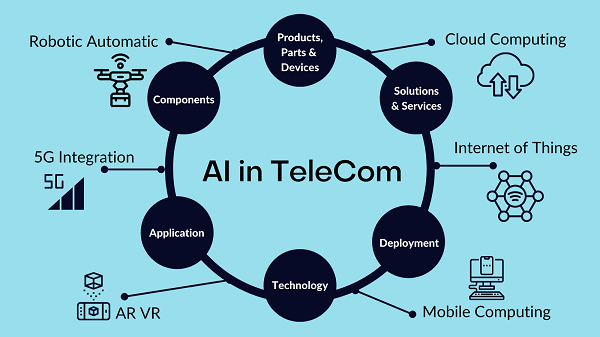
The telecommunications industry, the very backbone of our connected global society, is undergoing a profound and necessary evolution. At the heart of this transformation is the burgeoning AI In Telecommunication industry, a sector dedicated to embedding artificial intelligence into every facet of network operations, customer service, and business strategy. In a world defined by exponential data growth, the rollout of complex 5G networks, and intense competition, traditional, manual methods of managing telecom infrastructure are no longer viable. AI provides the essential intelligence layer needed to handle this complexity. The industry is focused on leveraging machine learning, natural language processing, and predictive analytics to automate processes, optimize performance, and create new value from the immense ocean of data that telcos generate every second. AI is not just another tool for telcos; it is becoming the central nervous system of the entire operation, enabling a shift from a reactive, human-driven model to a proactive, automated, and self-optimizing one, ensuring the future reliability and profitability of the world's most critical infrastructure.
The applications of AI within the telecommunications industry are vast, touching upon two primary domains: Network Operations and Customer Experience Management. In Network Operations, AI is revolutionizing how networks are planned, managed, and maintained. Predictive maintenance is a key application, where machine learning models analyze data from network equipment to predict component failures before they occur, allowing for proactive repairs and dramatically reducing unplanned downtime. AI is also crucial for Network Optimization. Sophisticated algorithms can analyze real-time traffic patterns and automatically re-route data to avoid congestion, ensuring a high quality of service for all users. In the era of 5G, with its complex network slicing and virtualization, AI-driven automation is not just an advantage; it is a necessity for managing the network's dynamic and multifaceted nature. On the Customer Experience front, AI is transforming how telcos interact with their subscribers. AI-powered chatbots and voicebots are handling a large volume of customer service inquiries 24/7, providing instant answers to common questions and freeing up human agents for more complex issues, thereby improving efficiency and customer satisfaction.
The competitive landscape of the AI in telecommunication industry is a dynamic ecosystem of diverse players. The major Network Equipment Providers, such as Ericsson, Nokia, and Huawei, are at the forefront, building AI capabilities directly into their 5G radio access network (RAN) and core network products. They are offering "AI-powered network automation" as a key feature of their infrastructure. The large IT and Cloud Giants, including IBM, Google, Microsoft, and Amazon Web Services (AWS), are also major players, providing the foundational cloud infrastructure and powerful AI/ML platforms (like Watson, Vertex AI, and SageMaker) on which many telcos are building their custom analytics and AI applications. A third critical segment consists of specialized AI software vendors who offer pre-built applications tailored for specific telecom use cases, such as churn prediction, fraud detection, or service assurance. These vendors often compete by offering deep domain expertise and a faster time-to-value than a general-purpose platform. Finally, the telcos themselves are becoming key players, building in-house data science teams to develop proprietary AI models that can provide a unique competitive advantage.
Looking ahead, the industry's trajectory is pointed towards the creation of fully autonomous, "zero-touch" networks. This long-term vision involves a network that can self-configure, self-heal, and self-optimize with minimal human intervention. AI will be the brain of this autonomous network, continuously monitoring performance, predicting future demand, and dynamically allocating resources to meet the stringent requirements of new 5G services like massive IoT and ultra-low-latency communications. Furthermore, AI will be the key to unlocking new revenue streams for telcos, moving them beyond being simple connectivity providers. By analyzing network and user data, telcos can offer valuable insights and "Analytics-as-a-Service" to other industries, such as retail, transportation, and urban planning. The future of the AI in telecommunication industry is not just about running the network more efficiently; it's about transforming the telco into an intelligent service platform at the very heart of the digital economy.
Explore More Like This in Our Trending Reports:

 English
 Arabic
 Spanish
 Portuguese
 Deutsch
 Turkish
 Dutch
Dutch
 Italiano
 Russian
 Romaian
 Portuguese (Brazil)
 Greek
Greek