
Adjusting Bimetal Iron Thermostat Operating Temperature Through Design
Introduction to Adjustable Temperature Control
Bimetal Iron Thermostats are widely used in temperature-regulated devices due to their simplicity, reliability, and predictable thermal response. A key question for designers and engineers is whether the operating temperature of the thermostat can be adjusted through changes in its structure or the thickness of the bimetal strip. Understanding these factors is crucial for customizing thermostats to specific applications while maintaining accuracy and durability.
Principle of Bimetallic Action
The thermostat relies on a bimetallic strip composed of two metals with different coefficients of thermal expansion. As the temperature increases, the metals expand at different rates, causing the strip to bend and activate the electrical switch. The temperature at which this bending occurs—known as the activation temperature—is influenced by the physical properties and geometry of the strip. Modifying the strip’s structure or thickness can therefore adjust the thermal response.
Effect of Thickness on Activation Temperature
The thickness of the bimetal strip affects both its flexibility and the amount of bending under heat. Thicker strips resist bending, requiring higher temperatures to achieve the same displacement needed for activation. Conversely, thinner strips bend more easily, activating at lower temperatures. By carefully selecting the thickness of the metals, manufacturers can fine-tune the operating temperature of a Bimetal Iron Thermostat to meet the requirements of specific appliances or industrial equipment.
Structural Adjustments and Geometry
Apart from thickness, structural factors such as strip length, curvature, and mounting configuration also influence the activation temperature. Longer strips or strips with pre-curved shapes may bend more or less under the same thermal input, altering the temperature at which the switch triggers. Additionally, the placement of the bimetal strip relative to the electrical contacts can further modify response characteristics. Thoughtful engineering of these structural parameters allows precise customization of thermostat behavior.
Material Considerations
While structural and geometric modifications are important, the choice of metals is equally critical. Different metals have varying thermal expansion coefficients, which directly affect the bending rate and, consequently, the activation temperature. By combining structural adjustments with optimal material selection, a Bimetal Iron Thermostat can be reliably designed to operate at a desired temperature range, ensuring both performance and safety.
Applications and Practical Limitations
Customizing activation temperatures through structure and thickness adjustments is particularly useful in appliances like ovens, heaters, and industrial temperature control systems. However, there are practical limitations: extreme adjustments may compromise repeatability, mechanical stability, or lifespan. Engineers must balance temperature customization with long-term reliability, ensuring the thermostat maintains consistent performance throughout its service life.
Conclusion
The operating temperature of a Bimetal Iron Thermostat can indeed be adjusted by modifying the thickness, structure, and geometry of the bimetal strip. These adjustments, combined with careful material selection, allow manufacturers to tailor thermostats for specific applications while maintaining accuracy and durability. By understanding the relationship between design parameters and thermal response, engineers can optimize both the performance and reliability of temperature-controlled devices.
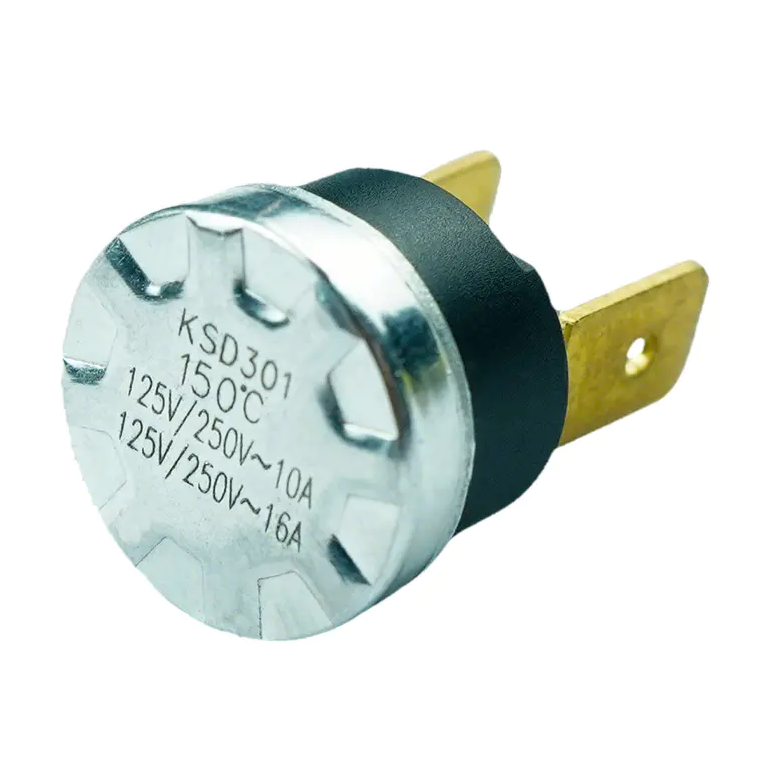
Rated Voltage: 125V/250V
Rated Current: 10A/16A
Life Cycle: 100000
Temperature: 0~180℃
Contact Type: NO/NC
Action Type A: automatic reset
Installation: Without mounting ring
Terminal: 4.8/6.3
Terminal Angle: Plane angle of 0°
Bend angle of 45°
Bend angle of 30°

 English
 Arabic
 French
 Spanish
 Portuguese
 Turkish
 Dutch
Dutch
 Italiano
 Russian
 Romaian
 Portuguese (Brazil)
 Greek
Greek