
Future of Board Exams: Digital, Adaptive & Skill-Based
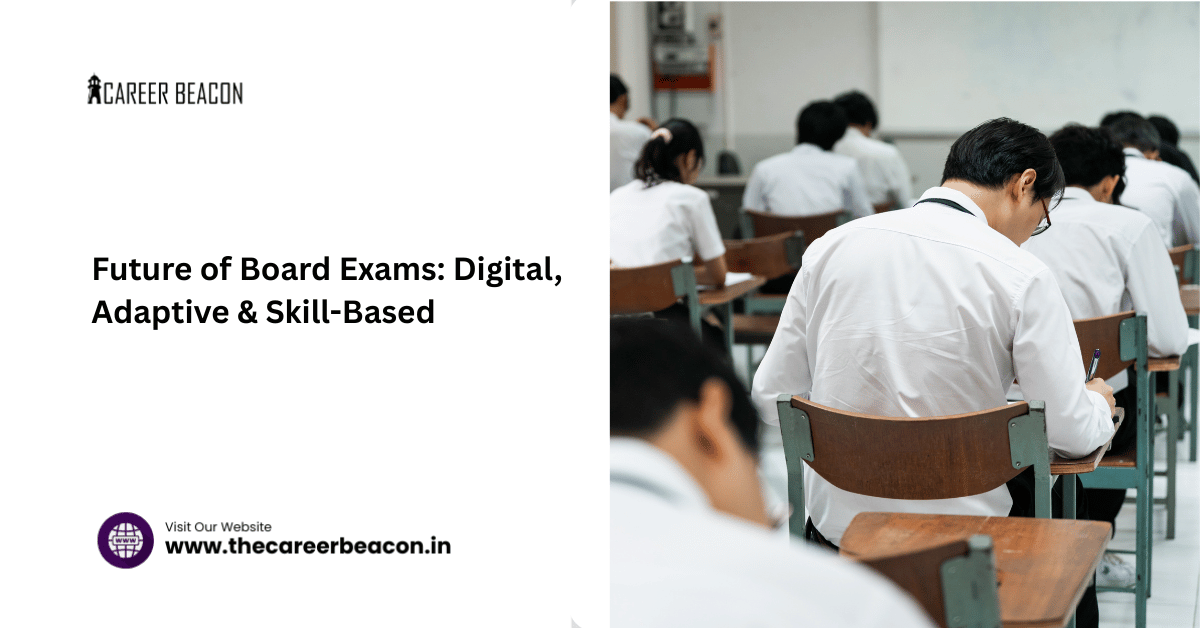
The direction of education has fundamentally changed in India, characterized by the way board examinations are being conducted. For years, the board exams have centered mainly around pen-and-paper based exams that reward memorization rather than real understanding. As the classroom moves into the 21st century and technology is incorporated into the learning, board exams are moving towards digital, adaptive, skill-based exams that will provide students a more meaningful and less stressful mode of evaluation.
The Need for a Modern Exam System
Traditional board exams have long been criticized for causing intense pressure and encouraging rote learning. A single three-hour test often decides a student's future, leaving little room to measure creativity, analytical abilities, communication skills, or digital awareness. These limitations are becoming more visible as the job market changes and demands new-age skills.
Today's global economy values problem-solving, adaptability, and the ability to think independently — qualities that traditional exams fail to assess. This gap has made educators rethink the purpose of board exams. If the goal of education is to prepare students for real life, then the exam system must test what truly matters.
Digital Exams: Taking a Big Step Forward
The development of digital test formats is a significant trend influencing the direction of board exams. Numerous competitive exams, including JEE, CAT, and several government exams, already administer tests in digital versions. Similar models are gradually being investigated by school boards.
Exams conducted digitally have a number of benefits. Students can receive findings more quickly due to the effective evaluation method, which eliminates the need for lengthy wait times. By reducing cheating through positive AI-based monitoring and identity verification, technology also improves exam security. By eliminating the superfluous paper that is typically used, the digital format is also more environmentally friendly.
Furthermore, digital testing allows a convenience that is more important than anything else: equity. Every student is placed in the same interface and all students are evaluated in standardized settings, provided a neutral evaluation process. Digital examinations can also be held in different sessions or slots to eliminate crowding in examination centers, while providing more flexibility.
In a few years, students may have their examinations conducted in computer studios rather than classrooms, and hand-written answer sheets may no longer exist.
Adaptive Exams: Tailored Testing for Every Student
While digital exams are a significant change, adaptive exams take innovation even further. In an adaptive exam, the difficulty of questions adjusts according to how a student performs. If the answers are correct, the system provides slightly harder questions. If a student struggles, the questions become easier, ensuring a personalized testing experience.
This model helps create a more accurate picture of a student's understanding. Instead of treating everyone the same, adaptive exams recognize individual learning levels. Students no longer face the pressure of extremely tough or unfamiliar questions. Instead, they interact with a test that adapts to their abilities.
Adaptive exams also reduce the role of guessing and memorization. They focus on comprehension, speed, and problem-solving — essential qualities for modern careers. Once the exam is complete, students receive detailed performance reports that highlight their strengths and areas that need improvement. This feedback-driven approach makes exams a tool for learning rather than fear.
Skill-Based Assessment: Moving Beyond Rote Learning
A significant shift in the future of board examinations is the move towards a skills-based assessment. Skills-based examinations do not rely on rote learned textbook knowledge, but look at how you can apply concepts in typical scenarios.
These assessments could consist of:
- Case studies
- Project work
- Practical assignments
- Real-life situation questions
- Concept-based questions
For example, a student of economics may be asked to evaluate contemporary market evidence as opposed to reciting memory definitions. A student studying science may solve real-life problems for exam questions rather than writing theoretical explanations.
The advantages of examinations based on skills are that it promotes creativity, critical thinking, and logical thinking – all gas have general skills required for tertiary study and employment. Skills-based exams could also ease the pressure of learners cramming the night before. Furthermore, skills-based assessment opens up the space for a whole year of learning that is not just focused on theory.
A Hybrid Model: Blending Traditional and Modern Methods
While digital and adaptive models are the future, the transition will not happen overnight. India is a large and diverse country, and schools differ in their access to technology and infrastructure. This is why many education experts believe that board exams will move toward a hybrid model .
In this system, exams may include:
-
A digital exam component
-
School-based assessments
-
Project submissions or practical evaluations
-
A smaller portion of traditional written exams
This balanced approach allows flexibility while maintaining the structure needed for large-scale exams. It also ensures that students from rural and urban areas have equal opportunities as the system evolves.
Barriers and the Way Forward
Board examinations seem to have a bright future, yet there are barriers that need to be overcome. One of the biggest barriers is still the digital divide; not every student has an equal opportunity to access devices or reliable internet. Schools need new labs and adequate teacher training to address digital and adaptive assessments.
Nevertheless, India is slowly transitioning towards a contemporary assessment ecology with the introduction of the NEP 2020 and increasing governmental investment in digital infrastructure. EdTech companies are also making their mark by providing digital solutions for schools and boards of examination.

 English
 Arabic
 French
 Spanish
 Portuguese
 Deutsch
 Turkish
 Dutch
Dutch
 Italiano
 Russian
 Portuguese (Brazil)
 Greek
Greek