
Haptics Technology: Transforming Human-Machine Interaction Through Touch
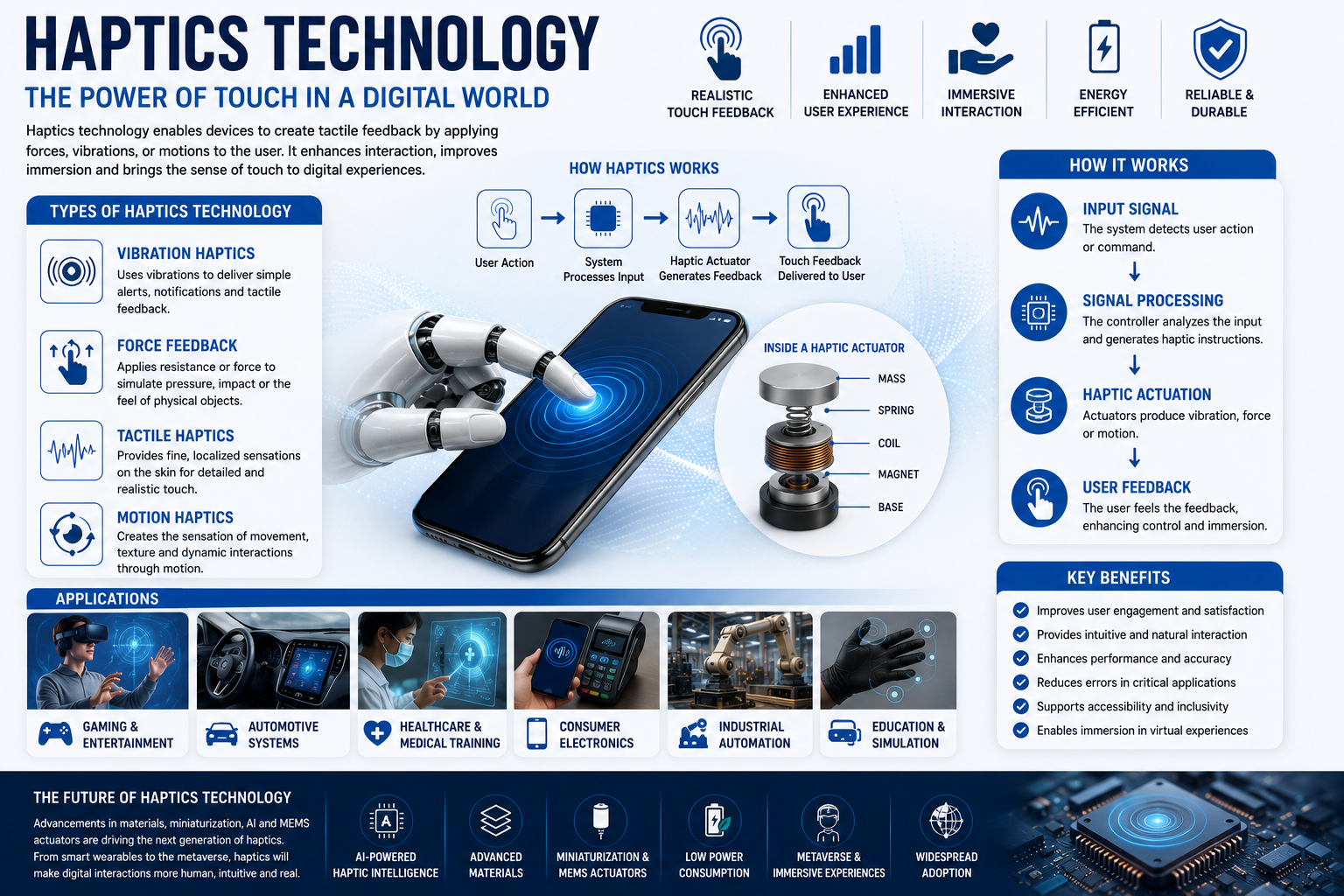
Haptics technology is revolutionizing the way people interact with digital devices by introducing the sense of touch into virtual and physical environments. Through vibrations, forces, and motion-based feedback, haptic systems enable users to feel digital interactions, making experiences more realistic, immersive, and intuitive. From smartphones and gaming consoles to healthcare, automotive systems, robotics, and industrial automation, haptics technology is reshaping human-machine interaction across multiple industries.
What Is Haptics Technology?
Haptics technology refers to the use of tactile feedback to simulate the sensation of touch. It works by generating vibrations, pressure, or motion that users can feel when interacting with electronic devices. Unlike visual and audio feedback, haptics adds a physical dimension, improving user engagement and enhancing communication between humans and machines.
There are several types of haptic technologies, including vibration haptics, force feedback, tactile feedback, and motion-based haptics. Each technology is designed to create different touch sensations depending on the application and user requirements.
Download PDF Brochure -https://www.marketsandmarkets.com/pdfdownloadNew.asp?id=443
Key Technologies Driving Innovation
Advancements in microelectromechanical systems (MEMS), artificial intelligence (AI), robotics, and advanced actuators are accelerating the evolution of haptics technology. Modern haptic systems offer greater precision, faster response times, lower power consumption, and more realistic tactile sensations.
AI-powered haptic algorithms can adapt feedback based on user behavior, making interactions smarter and more personalized. Flexible electronics, wearable devices, and compact actuators are also enabling lightweight, portable haptic solutions for next-generation consumer and industrial products.
Applications Across Industries
Haptics technology is becoming an essential component of digital transformation across numerous sectors.
Consumer Electronics: Smartphones, tablets, smartwatches, and gaming controllers use haptic feedback to improve typing, notifications, and immersive entertainment experiences.
Automotive: Modern vehicles integrate haptic feedback into touchscreens, steering wheels, and driver assistance systems to improve safety while reducing driver distraction.
Healthcare: Surgeons and medical professionals use haptic-enabled simulators for training, robotic surgery, rehabilitation, and remote medical procedures with enhanced precision.
Industrial Automation: Haptic interfaces improve robot control, remote equipment operation, predictive maintenance, and worker safety in manufacturing environments.
Virtual Reality (VR) and Augmented Reality (AR): Haptic gloves, suits, and controllers create realistic virtual interactions, making gaming, training, education, and product design more immersive.
Market Growth Drivers
Several factors are fueling the rapid adoption of haptics technology worldwide:
- Growing demand for immersive gaming and entertainment experiences.
- Rising adoption of virtual reality and augmented reality applications.
- Increasing use of wearable devices and smart consumer electronics.
- Expansion of robotics and industrial automation.
- Advancements in AI, MEMS actuators, and sensor technologies.
- Growing investments in medical simulation and robotic healthcare solutions.
Future Outlook
The future of haptics technology is closely connected to AI, robotics, extended reality (XR), and the metaverse. As actuators become smaller, more efficient, and more responsive, haptic feedback will become increasingly realistic and accessible across industries.
Future innovations will enable users to experience highly detailed touch sensations in remote collaboration, autonomous systems, telemedicine, digital commerce, and immersive virtual environments. Combined with AI and edge computing, haptic technology will deliver intelligent, context-aware interactions that improve productivity, safety, and user satisfaction.
As businesses continue investing in next-generation digital experiences, haptics technology will play a critical role in bridging the gap between humans and machines. Its ability to create natural, intuitive, and engaging interactions positions it as one of the most important technologies shaping the future of connected devices, smart manufacturing, healthcare, and immersive digital ecosystems.

 English
 Arabic
 French
 Spanish
 Portuguese
 Deutsch
 Turkish
 Dutch
 Russian
 Romaian
 Portuguese (Brazil)
 Greek