
How Probe Pins Ensure Precision in Electronics Manufacturing
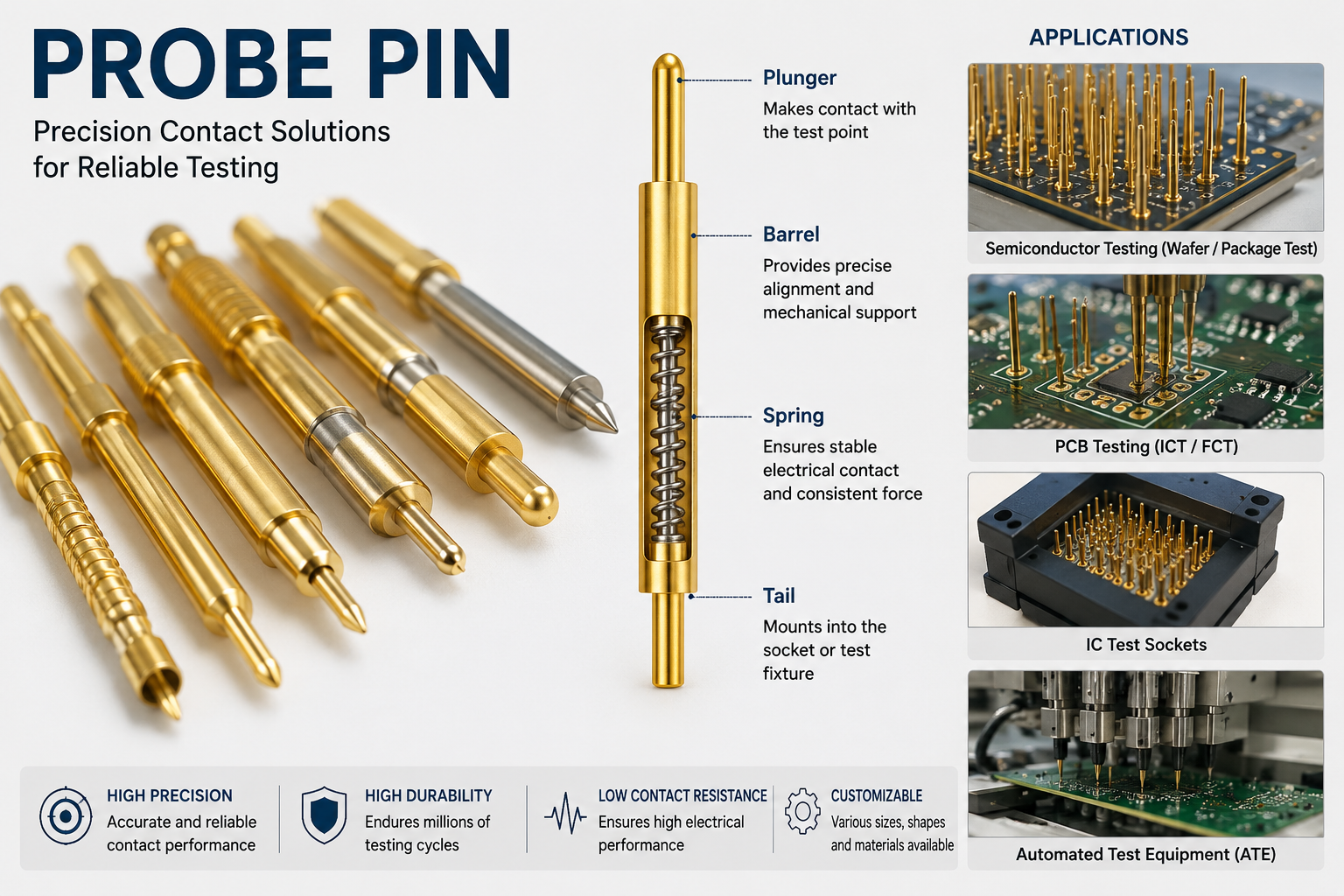
Probe pins are precision-engineered electrical contact components used to test the functionality, performance, and reliability of electronic devices, semiconductor chips, printed circuit boards (PCBs), and integrated circuits (ICs). Although small in size, probe pins play a critical role in the manufacturing and quality assurance processes of consumer electronics, automotive systems, telecommunications equipment, aerospace components, and medical devices.
As electronic devices become smaller, faster, and more complex, manufacturers require highly accurate testing solutions to ensure product quality before products reach the market. Probe pins provide temporary electrical connections between testing equipment and the device under test (DUT), enabling engineers to verify electrical performance without permanently attaching wires or connectors.
How Probe Pins Work
A probe pin consists of a spring-loaded plunger, barrel, and internal spring. When pressed against a test pad or semiconductor package, the spring compresses, ensuring a stable electrical connection despite slight variations in height or alignment. This design minimizes contact resistance while maintaining reliable signal transmission during repeated testing cycles.
Probe pins are commonly installed in test sockets, probe cards, automated test equipment (ATE), and in-circuit testing (ICT) systems. They are designed to withstand millions of test cycles while maintaining consistent electrical performance.
Download PDF Brochure -https://www.marketsandmarkets.com/pdfdownloadNew.asp?id=202218092
Applications Across Industries
The semiconductor industry is the largest consumer of probe pins. During wafer testing and final package testing, probe pins verify the functionality of chips before they are assembled into electronic products. High-performance computing processors, AI accelerators, memory chips, and power semiconductors all undergo extensive probe testing.
In the automotive sector, probe pins are used to test electronic control units (ECUs), battery management systems, advanced driver assistance systems (ADAS), and electric vehicle (EV) components. As vehicles become increasingly software-driven, reliable electronic testing has become essential.
Consumer electronics manufacturers use probe pins for testing smartphones, tablets, laptops, wearable devices, gaming consoles, and IoT products. Medical equipment manufacturers also rely on probe pins to validate diagnostic instruments, imaging systems, and implantable electronic devices where precision is critical.
Technological Advancements
Modern probe pins are evolving alongside semiconductor technology. With chip packages becoming denser and pin pitches shrinking, manufacturers are developing ultra-fine probe pins capable of testing high-density integrated circuits. Advanced materials such as beryllium copper, tungsten, and gold-plated alloys improve conductivity, durability, and corrosion resistance.
High-frequency probe pins are also gaining importance as 5G, AI, high-speed networking, and data center applications require testing at higher signal frequencies with minimal signal loss. Innovations in microfabrication and precision machining continue to enhance probe pin performance and lifespan.
Market Growth Drivers
Several factors are driving demand for probe pins worldwide:
- Rapid expansion of semiconductor manufacturing.
- Increasing production of electric and autonomous vehicles.
- Growing adoption of AI processors and high-performance computing chips.
- Rising demand for smartphones, wearables, and IoT devices.
- Expansion of 5G infrastructure and communication equipment.
- Higher investments in automated testing systems.
Asia-Pacific remains the largest market due to the presence of major semiconductor manufacturing hubs in countries such as Taiwan, South Korea, China, and Japan. North America and Europe continue to invest heavily in advanced semiconductor fabrication and electronic testing technologies.
Future Outlook
The future of probe pins is closely tied to advancements in semiconductor manufacturing, artificial intelligence, and next-generation electronics. As chip architectures become increasingly sophisticated and testing requirements become more demanding, probe pin technology will continue to evolve with greater precision, longer durability, and enhanced electrical performance.
Despite being one of the smallest components in electronic manufacturing, probe pins serve as a critical link between innovation and quality assurance. Their ability to deliver accurate, repeatable, and high-speed electrical testing makes them indispensable in ensuring the reliability of modern electronic products across virtually every technology-driven industry.

 English
 Arabic
 Spanish
 Portuguese
 Deutsch
 Turkish
 Dutch
 Italiano
 Russian
 Romaian
 Portuguese (Brazil)
 Greek