
Understanding You: How Natural Language Processing Systems and Conversational AI Platforms Enable Truly Intelligent Assistants
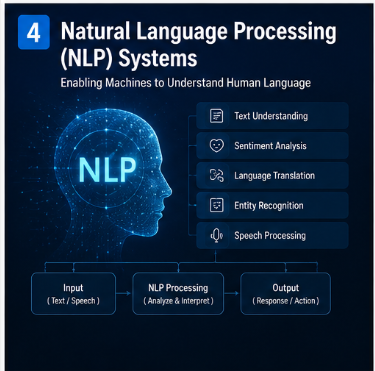
Ask any virtual assistant a straightforward question like "What is the weather today?" and it will likely provide a correct answer. But human communication is rarely that simple. We use sarcasm. We change topics mid-sentence. We reference things said earlier. We imply meaning without stating it directly. For a virtual assistant to be truly useful, it must navigate this complexity. This is the domain of Natural Language Processing Systems. NLP is the branch of artificial intelligence that enables computers to understand, interpret, and generate human language in all its messy, context-dependent glory. Without advanced NLP, virtual assistants would be little more than voice-activated search engines.
Building on this foundation, Conversational AI Platforms apply NLP capabilities to create complete, engaging conversational experiences. These platforms manage dialog flow, maintain context across multiple exchanges, integrate with backend systems, and generate appropriate responses. They transform raw language understanding into practical, useful conversations that can accomplish real tasks—booking travel, troubleshooting products, managing finances, or providing emotional support. The combination of sophisticated NLP and robust conversation management is what makes modern virtual assistants feel genuinely intelligent rather than merely automated.
What Is Natural Language Processing?
Natural Language Processing sits at the intersection of computer science and linguistics. It seeks to give computers the ability to understand human language as it is naturally spoken or written, rather than requiring humans to adapt their language to fit computer constraints.
The Components of NLP
NLP systems perform multiple transformations on raw language input. Tokenization breaks sentences into individual words or phrases for analysis. Part-of-speech tagging identifies whether each word functions as a noun, verb, adjective, etc. Named entity recognition identifies specific things like people, places, dates, and product names. Sentiment analysis determines the emotional tone of the communication. Coreference resolution connects pronouns like "it" or "they" to the nouns they refer to earlier in the conversation.
The Challenge of Human Language
Human language is ambiguous, context-dependent, and constantly evolving. The same words can mean different things in different situations. "I'm looking for a match" could refer to a romantic partner, a tennis opponent, or a fire-starting device. Resolving this ambiguity requires understanding the broader context of the conversation and the user's likely intent. NLP systems use statistical models trained on massive text corpora to make these determinations with increasing accuracy.
How NLP Enables Conversational AI
Raw language understanding is necessary but not sufficient for effective conversation. Conversational AI platforms add the capabilities needed to turn understanding into useful interaction.
Intent Recognition
Intent recognition determines what the user is trying to accomplish. Is the user asking for information, requesting an action, complaining about a problem, or just making small talk? Each intent requires a different response strategy. Sophisticated intent recognition can distinguish between similar intents—asking "What time is it?" versus asking "How much time do I have?"—based on subtle language cues.
Entity Extraction
Once intent is determined, the system must extract the specific entities relevant to fulfilling that intent. For a "book flight" intent, entities might include origin city, destination city, departure date, return date, number of passengers, and class of service. Entity extraction identifies these values from the user's utterances, even when they are not presented in a consistent format.
Dialog Management
Dialog management maintains conversation state across multiple exchanges. The system must remember what has already been discussed, what information has been collected, and what information is still needed. When a user asks "What about Tuesday?" after previously discussing flights on Monday, the system understands that Tuesday refers to a different potential departure date for the same trip.
Response Generation
Finally, the system must generate an appropriate response. This may be a simple answer to a question, a request for missing information, confirmation of an action taken, or a suggestion for next steps. Response generation can be template-based (filling slots in pre-written sentences) or generative (creating novel sentences from scratch using language models).
Advanced NLP Capabilities in Modern Assistants
Contextual Understanding
Early NLP systems processed each sentence independently, losing information that connected sentences to each other. Modern systems maintain context across longer conversations, understanding references to earlier topics and remembering user preferences stated previously. A user who says "I like Italian food" and later asks "What's near me?" will receive Italian restaurant recommendations, not just any restaurants.
Sentiment and Emotion Detection
Advanced NLP systems detect emotional tone from word choice, sentence structure, and even typing patterns. A user who writes "I GUESS I'll just WAIT LONGER" in all caps with sarcastic spacing is likely frustrated, even though the literal words do not express frustration. Detecting this sentiment allows the assistant to respond with appropriate empathy or escalate to a human agent.
Multilingual Capabilities
Modern NLP systems support dozens of languages and can even switch between languages mid-conversation. A bilingual user might ask a question in Spanish, receive an answer in Spanish, then switch to English for a follow-up—all without the assistant missing a beat. This capability is essential for global businesses and diverse communities.
Real-World Applications of NLP-Powered Conversational AI
Healthcare Triage and Information
Healthcare organizations are deploying NLP-powered assistants to help patients navigate their care. A patient describing symptoms in everyday language might say "I have a sharp pain in my lower right side that comes and goes." The NLP system extracts the key medical concepts—pain, sharp quality, lower right location, intermittent pattern—and maps them to standardized medical terminology. It can then provide appropriate triage guidance or route the patient to the right specialist.
Financial Services and Banking
Banking customers ask complex questions that require understanding of financial concepts and account context. "What was that charge from last week in Chicago?" requires the system to understand time references ("last week"), location context ("in Chicago"), and transaction types ("charge"). NLP systems extract these entities, query the transaction database, and return the matching result—all through natural conversation.
Legal and Compliance Applications
Law firms and compliance departments are using NLP-powered assistants to review documents, answer policy questions, and guide employees through complex regulations. An employee asking "Can I accept a lunch from a vendor?" receives an answer based on the specific gift policy applicable to their role and location. The assistant understands the underlying legal concepts even when the employee uses informal language.
The Technology Stack Behind Modern NLP
Machine Learning Models
Modern NLP is powered by large language models trained on massive text datasets. These models learn statistical patterns of language use, enabling them to predict likely meanings and appropriate responses. The largest models contain hundreds of billions of parameters and are trained on trillions of words.
Training Data Requirements
Effective NLP requires diverse, representative training data. If a system is trained primarily on formal written text, it will struggle with casual spoken conversation. If training data lacks examples of non-native speakers, the system will have difficulty understanding accents and grammatical variations. Building comprehensive training datasets is expensive but essential for robust performance.
Continuous Learning
The best NLP systems continuously learn from their interactions. When a user rephrases a question because the system did not understand the first attempt, that interaction can be used to improve future performance. This continuous learning loop means that NLP systems get better over time, particularly for specific domains and user populations.
Challenges and Limitations
Ambiguity Remains Difficult
Despite dramatic advances, human language remains ambiguous in ways that confound even the best NLP systems. Sarcasm, irony, and implied meaning are particularly challenging. A user who says "Great, just great" after a problem occurs is expressing frustration, but the literal words are positive. Distinguishing literal from ironic language requires deep contextual understanding that current systems lack.
Domain Adaptation
An NLP system trained on general text may perform poorly on specialized domains like medicine, law, or engineering. These domains have unique vocabularies, grammatical patterns, and conventions. Adapting a general system to a specific domain requires additional training on domain-specific text.
Computational Requirements
Large NLP models require significant computational resources, particularly for real-time conversation. Running a sophisticated model on a smartphone is challenging, requiring either simplified models or cloud-based processing that introduces latency and privacy concerns.
The Future of NLP and Conversational AI
The market for intelligent personal assistants is projected to grow from $16.58 billion in 2025 to $268.26 billion by 2035, driven largely by advances in NLP.
Multimodal Understanding
Future NLP systems will incorporate non-linguistic cues into their understanding. Tone of voice, facial expression, gesture, and environmental context will all inform language interpretation. An assistant that sees the user is rushing will respond with briefer answers than one that sees the user is relaxed.
Explainable AI
As NLP systems make more consequential decisions—approving loans, diagnosing medical conditions, providing legal advice—the ability to explain their reasoning becomes essential. Future systems will not just provide answers but explain how they arrived at those answers, building trust and enabling human oversight.
Personalized Language Models
Rather than using the same model for all users, future systems will maintain personalized language models that adapt to individual speech patterns, vocabularies, and communication preferences. Your assistant will sound more like you over time, using the words and phrases you prefer.
Conversational AI Platforms would be impossible without the foundational capabilities provided by Natural Language Processing Systems. NLP enables machines to navigate the complexity, ambiguity, and context-dependence of human language, transforming raw speech or text into understood meaning. As NLP continues to advance, virtual assistants will become even more capable, more natural, and more useful—understanding not just what we say, but what we truly mean.

 English
 Arabic
 French
 Spanish
 Portuguese
 Deutsch
 Turkish
 Dutch
Dutch
 Russian
 Romaian
 Portuguese (Brazil)
 Greek
Greek