
How Does Automotive Plastic Injection Mold Actually Work?
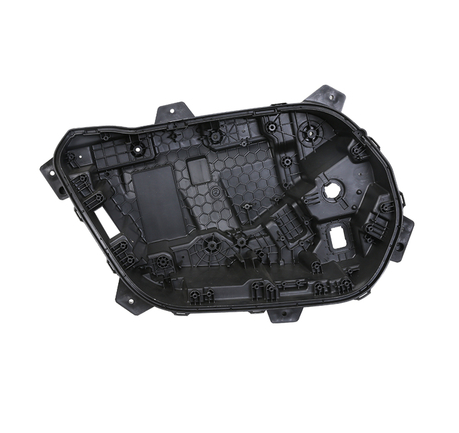
Open up the door panel of almost any modern vehicle and you're looking at the output of an automotive plastic injection mold. The trim pieces, clip housings, vent grilles, and structural brackets that make up the interior environment of a car are overwhelmingly plastic components, and virtually all of them started their existence as molten resin injected into a precisely engineered steel or aluminum cavity. It's a manufacturing process that operates largely out of sight, but it underpins the entire automotive supply chain.
The injection molding process itself follows a consistent sequence. Plastic pellets — typically engineering-grade resins like ABS, polypropylene, nylon, or polycarbonate, chosen for their specific mechanical and thermal properties — are fed into a heated barrel where they melt into a viscous flow. A reciprocating screw then pushes this molten material under high pressure through a gate and into the closed mold cavity. The automotive plastic injection mold holds the material in shape while cooling channels circulating water extract heat and solidify the part. Once cooled, the mold opens and ejector pins push the finished component free.
The design of an automotive plastic injection mold is where the real engineering complexity lives. Every surface, angle, and feature of the finished part must be achievable within the constraints of a tool that opens, fills, cools, and ejects in a repeatable cycle. Draft angles — slight tapers built into vertical walls — allow the part to release from the mold without dragging or distorting. Undercuts, where part geometry would otherwise prevent clean ejection, require side actions or lifters that move laterally as the mold opens. Gate placement influences how the molten plastic flows through the cavity, which in turn affects surface finish, weld line location, and internal stress distribution.
Dimensional consistency is non-negotiable in automotive applications. A dashboard component that varies even slightly between cycles creates fitment problems on the assembly line. The automotive plastic injection mold must maintain tight tolerances cycle after cycle, which demands careful attention to cooling system design, clamp force, and material shrinkage compensation during the mold-making process.
Surface finish requirements add another layer of consideration. Visible interior components often require a textured or high-gloss surface that must be replicated identically across every part the mold produces.

 English
 Arabic
 French
 Spanish
 Portuguese
 Deutsch
 Turkish
 Dutch
Dutch
 Italiano
 Russian
 Portuguese (Brazil)
 Greek
Greek