
Smart Personal Safety and Security Device Market: Connected Wearables and Intelligent Personal Protection Systems
Executive Summary
The Smart Personal Safety and Security Device Market is undergoing a period of rapid evolution, driven by the convergence of IoT, AI-driven threat detection, and the rising global demand for individual protection. These devices, ranging from smart jewelry to wearable panic buttons, provide real-time SOS alerts, GPS tracking, and health monitoring to vulnerable demographics, including women, children, and the elderly. As urbanization increases and personal security concerns intensify, the market is shifting toward discreet, aesthetically pleasing designs that integrate seamlessly into daily life.
Market Overview
Smart personal safety and security devices are internet-connected hardware designed to enhance individual safety through remote monitoring and emergency signaling. Unlike traditional security systems, these portable devices focus on the "person" rather than a fixed "place." Key technologies such as Bluetooth Low Energy (BLE), 5G cellular connectivity, and Global Positioning Systems (GPS) allow users to trigger instant alerts to emergency contacts or local authorities. The integration of sensors for fall detection and biometric monitoring has further expanded the market's utility into the healthcare and industrial safety sectors.
Market Size & Forecast
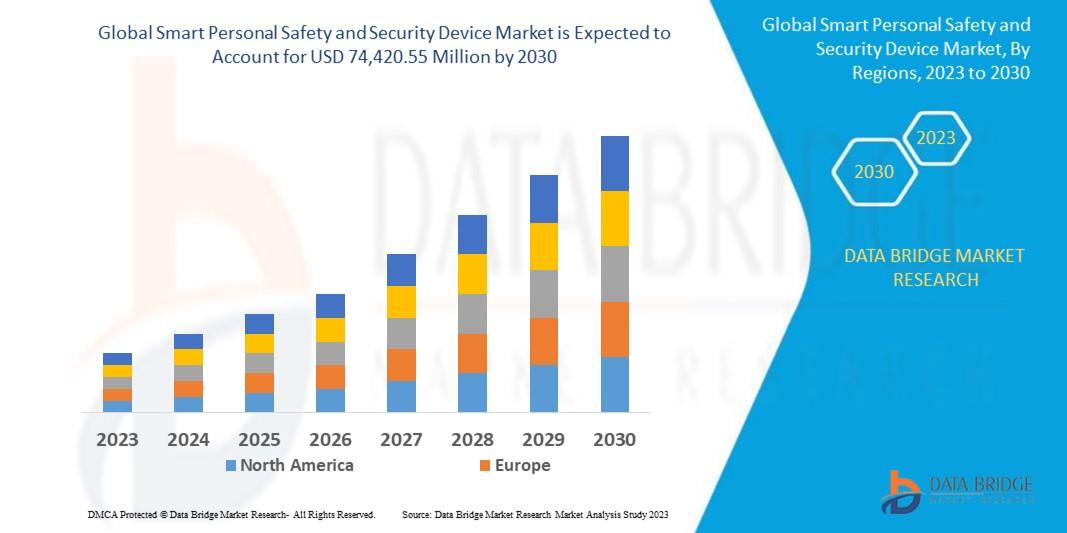
The global Smart Personal Safety and Security Device Market was valued at approximately USD 41.31 Billion in 2024. It is projected to experience robust growth, reaching a valuation of USD 74.92 Billion by 2032. This represents a CAGR of 7.78% during the forecast period from 2025 to 2032. Factors such as the 30% annual growth in remote patient monitoring reimbursements and the shipment of over 530 million wearables globally in 2024 are significant contributors to this upward trajectory.
Market Segmentation
The market is segmented to address various user needs and technological requirements:
- By Device Type:
- Smart Jewellery: Accounted for 28.4% of the market in 2024, favored for its discreet nature (rings, necklaces).
- Wearable Devices: Includes smartwatches and fitness trackers with integrated SOS features.
- Smart Clothing: Projected to witness the highest CAGR due to its application in high-risk industrial environments.
- Other Devices: Panic buttons, smart helmets, and bulletproof bags.
- By Technology:
- Bluetooth: Dominant segment (approx. 39.3% share) due to low power consumption.
- Cellular Network: Fast-growing segment driven by 4G/5G expansion for untethered, long-range safety.
- By End-User: Consumer Electronics (largest share at 35.7%), Healthcare, Defense, and Factories.
Regional Insights
North America held the leading market share in 2024, valued at USD 16.26 Billion, supported by high consumer awareness and a strong presence of technology giants like Apple and Garmin. However, the Asia-Pacific region is expected to witness the highest CAGR of 14.47%. This surge is fueled by rapid urbanization in India and China, increasing disposable incomes, and government initiatives aimed at improving women's safety through the distribution of wearable safety tech.
Competitive Landscape
The market is characterized by intense competition between established consumer tech firms and specialized safety startups. Innovation in AI analytics for real-time threat assessment is a key differentiator.
Top Market Players:
- Apple Inc.
- Samsung Electronics Co. Ltd.
- Honeywell International Inc.
- ADT Inc.
- Fitbit (Google LLC)
- Garmin Ltd.
- Huawei Technologies Co. Ltd.
- Revolar Inc.
- Safelet B.V.
Trends & Opportunities
- Discreet Safety "In Disguise": A move toward hidden panic buttons in everyday accessories like bracelets and pendants to prevent attacker detection.
- AI and Predictive Alerts: Transitioning from reactive SOS buttons to AI-driven predictive health and safety alerts that monitor vitals and environment.
- Subscription-Based Ecosystems: Expansion of monitoring-as-a-service, where hardware is bundled with 24/7 professional monitoring response teams.
- Industrial IoT (IIoT) Integration: Smart helmets and vests that track lone workers in hazardous zones like oil rigs or construction sites.
Challenges & Barriers
- Data Privacy and Hacking: Since these devices track precise GPS logs and personal habits, they are high-value targets for cybercriminals.
- High Costs of Advanced Features: AI-powered safety devices can cost 45% more than standard wearables, limiting adoption in price-sensitive emerging markets.
- Battery Life Constraints: Continuous GPS and cellular tracking significantly drain battery, which can be critical during a multi-hour emergency.
Conclusion
The Smart Personal Safety and Security Device Market is set to become an essential pillar of modern lifestyle and workplace safety. While privacy concerns and hardware costs remain hurdles, the rapid expansion of 5G networks and miniaturized sensors will continue to drive adoption. Moving forward, the market will likely see a deeper integration between personal wearables and smart city infrastructures to ensure faster, automated emergency responses.
Browse Trending Report: Smart Personal Safety and Security Device Market
Contact Us:
Data Bridge Market Research
US: +1 614 591 3140
UK: +44 845 154 9652
APAC: +653 1251 975

 English
 Arabic
 French
 Spanish
 Portuguese
 Deutsch
 Turkish
 Dutch
Dutch
 Italiano
 Russian
 Romaian
 Portuguese (Brazil)