
Europe’s Fast-Charging Network: Opportunities, Challenges, and Trends
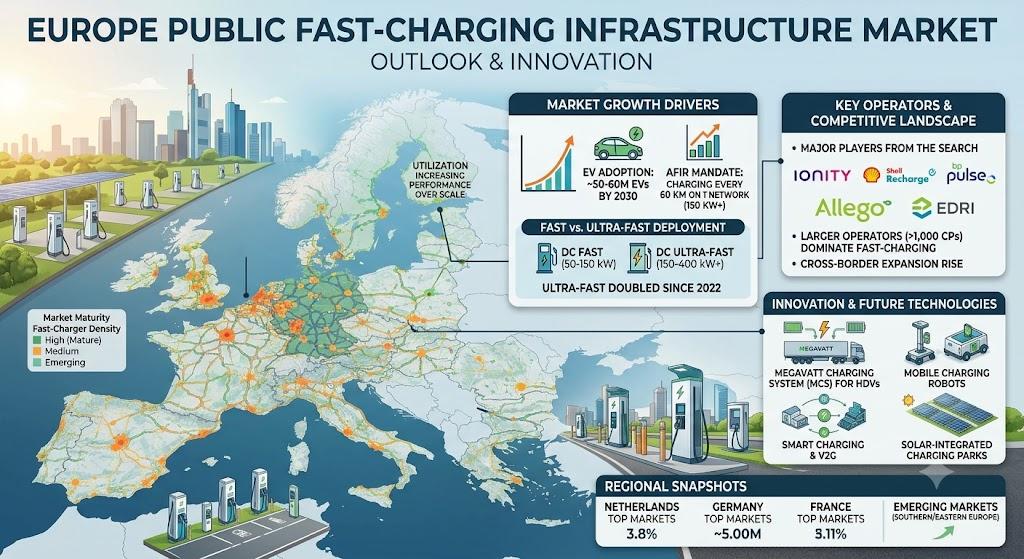
How Europe’s Public Fast-Charging Industry Is Evolving
Europe’s public charging landscape is moving toward a more mature phase in which network quality matters as much as infrastructure volume. Electric vehicle adoption is expanding, but drivers judge charging networks through practical experiences: whether a station is available, whether the connector works, how long a session takes, what it costs, and whether payment is simple. These expectations are shaping investment priorities across the region.
Fast charging has a distinct role within the wider charging ecosystem. Home and workplace charging can cover many routine needs, while public high-power stations support longer journeys, apartment residents, commercial vehicles, and drivers without dedicated parking. This complementary relationship means public infrastructure should be planned alongside broader mobility patterns rather than treated as an independent technology segment.
One emerging priority is network density along strategic corridors. Drivers traveling between cities need confidence that another charging opportunity will be available when required. Corridor planning should consider traffic volumes, vehicle range, existing stations, grid capacity, and future electric vehicle adoption. A balanced network can reduce range anxiety and support more frequent long-distance electric travel.
Urban deployment requires a different approach. City charging sites must operate within constrained space and complex transport environments. Municipalities may need to coordinate parking arrangements, traffic rules, pedestrian access, electrical works, and public-space design. Strategic placement can also improve access for residents who cannot install chargers at home, helping make electrification more inclusive.
The economics of charging sites depend heavily on utilization. Revenue rises when chargers serve more vehicles, but utilization is affected by location, competition, vehicle density, pricing, operating hours, and charger reliability. Developers therefore need realistic demand forecasts instead of assuming that regional electric vehicle growth will automatically translate into strong performance at every site.
Electricity costs can materially influence operating margins. Fast-charging sites may face energy prices, network charges, and demand-related costs that vary by market and time. Intelligent charging controls can help operators manage these expenses by allocating power efficiently. Battery storage may provide additional flexibility where the economics and physical conditions are favorable.
The Europe Public Fast-Charging Infrastructure Industry is becoming increasingly connected with software, energy management, real estate, and fleet services. This broader ecosystem creates opportunities for companies that can combine charging assets with digital platforms, energy solutions, partnerships, and specialized customer programs.
Fleet electrification is especially relevant. Commercial vehicles often travel more kilometers than private cars and can create repeat charging demand. Operators can work with logistics companies, taxis, rental businesses, and service providers to develop charging arrangements based on usage patterns. Such relationships may support predictable revenue and justify investment in strategically located high-power sites.
Public authorities can influence the pace and shape of deployment through funding, planning rules, infrastructure targets, and interoperability requirements. Consistent regulations can encourage private investment, while streamlined permitting can shorten project schedules. Coordination among national governments, municipalities, utilities, and private operators remains important because charging networks frequently cross administrative boundaries.
Investment decisions should also consider future flexibility. Vehicles may become more energy efficient, battery capacities may change, and charging speeds may increase. Sites designed with expandable electrical infrastructure and adaptable layouts can respond more easily to these shifts. Digital systems should likewise support upgrades without requiring complete network replacement.
Europe’s public fast-charging transition ultimately depends on building confidence among drivers and investors. Reliable stations, practical locations, adequate capacity, transparent pricing, and responsive operations can create that confidence. As infrastructure becomes more integrated with electricity and mobility systems, public fast charging can support a transport network in which electric vehicles are practical for daily travel, commercial activity, and long-distance journeys while supporting practical transport electrification across Europe over the coming years.

 English
 Arabic
 French
 Spanish
 Portuguese
 Turkish
 Dutch
Dutch
 Italiano
 Russian
 Romaian
 Portuguese (Brazil)
 Greek
Greek