
Beyond the Cell: How Commercial EV Energy Storage Systems Are Reshaping Fleet Economics
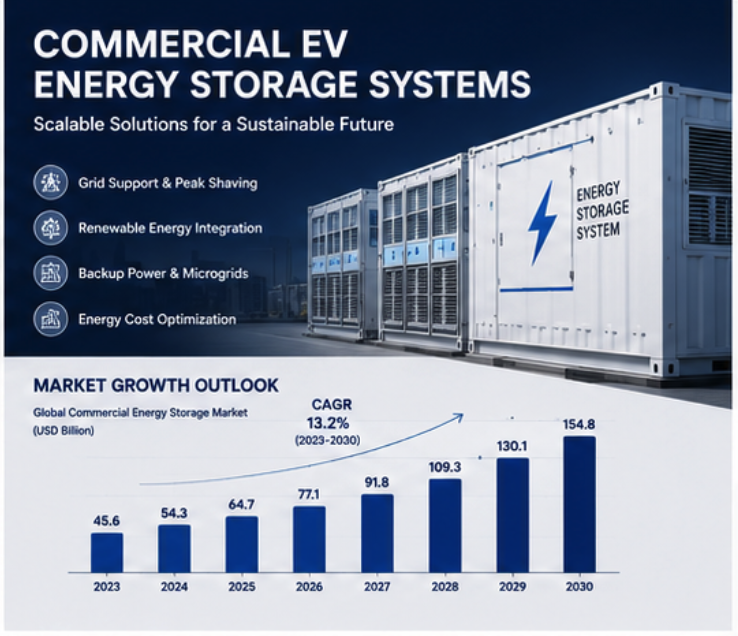
When a fleet operator contemplates electrification, they often focus on the vehicle itself—the truck, the van, or the bus. However, the true intelligence of an electric commercial vehicle lies not in its wheels or chassis, but in its energy storage system. Commercial EV Energy Storage Systems encompass far more than just cells; they include thermal management, power electronics, structural packaging, and sophisticated software. At the core of these systems are Lithium-Ion Battery Packs, which provide the raw energy that keeps goods moving and businesses profitable.
Total Cost of Ownership: The Real Metric
For commercial fleets, the purchase price of a vehicle is only one factor in a complex economic equation. Total Cost of Ownership (TCO) considers fuel (or electricity), maintenance, downtime, and residual value. Electric commercial vehicles powered by modern energy storage systems are rapidly achieving TCO parity with diesel, and in many applications, superiority.
Electricity costs approximately one-third to one-half as much as diesel per mile. Furthermore, electric powertrains have dramatically fewer moving parts—no oil changes, no exhaust systems, no transmissions (in most designs). The battery pack remains the largest variable cost. However, with Lithium-Ion Battery Packs now rated for 5,000+ cycles, a delivery van could operate for 15 years on its original pack, spreading that initial capital expense over a very long operational life.
The Role of Battery Management Systems
A Commercial EV Energy Storage Systems is only as intelligent as its management electronics. The Battery Management System (BMS) continuously monitors every cell's voltage, temperature, and state of charge. It balances cells to ensure uniform aging, prevents over-discharge that could permanently damage the pack, and communicates with the vehicle's central computer to predict remaining range with remarkable accuracy.
For fleet operators, this intelligence translates directly to operational confidence. A BMS that can accurately predict state of health (SOH) allows planners to schedule vehicles for battery maintenance or replacement before unexpected failures occur. Some advanced systems even use cloud connectivity to aggregate data across an entire fleet, identifying patterns that predict which vehicles are likely to experience premature degradation.
Charging Infrastructure Integration
Energy storage systems do not operate in isolation; they are part of a broader ecosystem that includes charging infrastructure. The emergence of the Megawatt Charging System (MCS) standard, capable of delivering up to 3.75 megawatts to a commercial vehicle, is a game-changer for long-haul trucking. With MCS, a 500 kWh battery pack could be charged from 20% to 80% in approximately 15 minutes—comparable to a diesel refueling stop.
However, such extreme charging rates place enormous stress on Lithium-Ion Battery Packs. Manufacturers are responding with specialized "fast-charge" cells that use thicker electrodes and modified electrolytes to withstand the lithium plating that occurs during high-rate charging. These cells may have slightly lower energy density, but the trade-off is acceptable for fleet applications where rapid turnaround is paramount.
Second Life and Recycling
One of the most compelling economic arguments for commercial EV energy storage is the second-life market. After a battery pack degrades to 70-80% of its original capacity, it is no longer suitable for vehicle propulsion but retains substantial value for stationary applications such as grid energy storage, peak shaving for warehouses, or backup power.
Companies like Northvolt and Tesla are building dedicated facilities to disassemble end-of-life packs, test individual modules, and reassemble them into stationary storage units. Eventually, when modules are truly exhausted, recycling processes recover over 95% of the lithium, nickel, cobalt, and manganese for use in new batteries. This circular economy dramatically reduces the lifetime environmental impact of Commercial EV Energy Storage Systems.
Conclusion
The electrification of commercial fleets is not merely an environmental imperative; it is increasingly an economic one. Commercial EV Energy Storage Systems, powered by advanced Lithium-Ion Battery Packs, offer lower operating costs, reduced maintenance, and predictable long-term performance. Fleet operators who embrace this technology today will be the logistics leaders of tomorrow.

 English
 Arabic
 French
 Spanish
 Portuguese
 Turkish
 Dutch
Dutch
 Italiano
 Russian
 Romaian
 Portuguese (Brazil)
 Greek
Greek